
Mosin Nagant Identification Guide

Izhevsk Factory
(Post 1928)

Tula Factory
(Post 1928)
.jpg)
Izhevsk Factory
(Pre 1928)

Tula Factory
(Pre 1928)
Factory Identification
While many different factories produced the Mosin between 1892 and 1960, the main two factories were the Tula & Izhevsk factories in Russia. They would produce the majority of rifles that served the Russians in both The Great War, as well as The Great Patriotic War
Tula Weapons Factory, 1912

Tula Barrel Markings


Tula M91 rifle produced in 1897
Tula M91 rifle produced in 1917
Tula M91/30 rifle produced in 1938
Izhevsk Weapons Factory, around 1910

Izhevsk Barrel Markings


Izhevsk Cossack rifle produced in 1895
Izhevsk M91/30 rifle produced in 1938
Izhevsk M38 carbine produced in 1941

Beginning in 1938, a prefix consisting of two Cyrillic letters was added to serial numbers
Receiver Markings

The vast majority of Mosins will have a factory marking, along with a year of production, on the bottom of the receiver tang


1944 Izhevsk tang marking
1897 Tula tang marking
1933 Tula tang marking


1894 Chatellerault tang marking
1898 Izhevsk tang marking
1901 Sestroretsk tang marking
Barrel Markings

1942 Tula Ex Sniper

1944 Izhevsk Ex Sniper
These markings read:
"Imperial Tula Weapons Factory 1910"
The 'Г' marking after the date is an abbreviation for 'Год', which is Russian for 'Year'


These markings read:
"Izhevsk Weapons Factory 1920"
These markings read:
"Sestroretsk Weapons Factory 1895"
One of the more collectible manufacturers, the Sestroretsk factory produced M91 rifles near St. Petersburg from 1893 - 1918
.jpg)
Arrow markings stamped by the Sestroretsk factory


Châtellerault Barrel Markings

When Mosin production began in 1892, the three Russian factories could not ramp production quickly enough. Fortunately for Russia, they had just signed a cooperation treaty with France. Russia would sign a contract with the Châtellerault factory in France to produce M91 rifles, and they would go on to produce 503,539 rifles from 1892 to 1895
Châtellerault is the most collectable out of all early Mosin manufacturers. Relatively few rifles were produced, and most of these rifles were lost between the Russo-Japanese War, WW1, and WW2

These markings read:
"Weapons Factory Chatellerault 1895"

Some example markings of the Chatellerault factory


American Barrel Markings
Because of a severe rifle shortage during WW1, The Russian government contracted with Remington and New England Westinghouse to produce millions of M91 Mosin rifles from 1916-1918


Remington M91 produced in 1917
Westinghouse M91 produced in 1918

Remington would use the 'R' in a circle on their parts. Here are a few markings used by the Westinghouse factory, which can often be found on Finnish Mosins since they utilize many recycled components


Factory Proof Markings
Rifles fired a black powder proof round in the factory to help check for imperfections in the metal. If the rifle passed the test, it was marked with a Cyrillic 'П' in a circle


Around 1940, the black powder proof test was replaced with a smokeless high pressure proof test. The Izhevsk factory would change to a "Y" in a circle, while the Tula factory would keep the Cyrillic 'П' in a circle
The rifles were also tested for their accuracy at the factory, and the minimum requirement was probably around 5 MOA. If the rifle passed the test, it was stamped with a 'K' in a circle

Sniper Rifle Markings

For most years, Mosin sniper rifles had a separate production line for their barrels. During WWII, the Tula factory would stamp a "C" and a "H" on the barrel to indicate a sniper grade barrel. From 1934 to 1940, the Tula factory would stamp a "C" and a "П" on the barrel
The Izhevsk factory began Sniper production in 1942. Around the middle of 1942, they would establish a dedicated sniper barrel production line, and would begin stamping sniper grade barrels with a "C" inside a circle


The Izhevsk factory would also stamp the serial number of the rifle's scope on the left side of the barrel shank. The Tula factory would never do this, but sometimes the serial number was stamped after the war, during refurbishment
Cossack Marking

The Izhevsk factory produced a small amount of Cossack rifles until 1922. These rifles were special because they were sighted in without the bayonet attached so that they could be easily shot from horseback. This is the most well know and most collectable Mosin marking, and is very seldomly seen. These are easily identified by the letters KA3. on the barrel

Capture Markings

Finland
The most common capture marking is from Finland, who stamped a "SA" in a box on their rifles. This stands for "Suomen Armeija", indicating Finnish Army property. Finland began using this marking on June 26th, 1942
On the very rare occasion, this marking can be found on Soviet refurbished 91/30s, indicating capture by Finland and then re-capture by the Soviets
Finland's main variant was the M91 pattern. They would modify the Russian sightbases by adding numbered graduations, in Meters, to the right side of the sight base


Finnish Civil Guard
The Finnish Civil Guard was responsible for acquiring their own weapons. After WW1, they would sign contracts for new Mosin barrels with SIG in Switzerland, and Venus Waffenfabrik in Germany.
The Finnish Civil Guard's logo was a shield containing the letter 'S' with three trees protruding from the top


Austro-Hungarian Empire

Another capture marking you can find on Mosin rifles is from the Austro-Hungarian empire. They captured thousands of rifles during WWI, and the most common marking is an "AZF", which stands for Artillerie Zeugs Fabrik
Most of these rifles were later acquired by Finland, so you will typically see Finnish markings on these rifles as well. This M91 was re-barreled by Tikkakoski in 1940

Many rifles were refurbished at OWEG Steyr in Austria. Some of these were also converted to "squeezebores" by having the chamber opened up to accept the larger 8x50r Austrian cartridge

A less common marking is the S2. marking which is found the barrel of Mosins which were re-issued to Austro-Hungarian units

A few Mosins were refurbished by Johann Springer's Erben, who was a fine gunmaker for the imperial Austrian court. This company is still around to this day
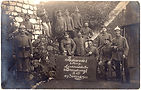

Germany
Germany captured hundreds of thousands of Mosins during The Great War, and would redeploy many of them to the western front. Some of these rifles are marked "Deutschland" on the receiver, however most rifles had no markings on the receiver. The standard practice was to stamp "Deutsches Reich" on the right side of the stock.
They would also send at least 87,000 Mosins to aid Finland in 1918, during their civil war against the reds
Artillerie Depot Graudenz
(A.D.Grdz. - Grudziadz, Poland)

Deutsches Reich
WW1 German property marking


Germany also captured tens of thousands of Mosins during WW2. Most of these never received any formal markings, however a few were marked property of the Luftwaffe. These markings read F.L.P. Riga, which was a Luftwaffe outpost in Riga, Latvia. These markings can very occasionally be found on re-captured, refurbished 91/30 rifles and are extremely collectible